Friday, July 21, 2017

Sarkar 3: Why not?

There are few reasons to watch Sarkar 3, after the nearly unanimous hostile critical reception. Film companion even called it an act of film terrorism (Baradwaj Rangan was far more kind). But it was a Tuesday night when tickets are selling at half the price. Even more importantly, long after its release I was impressed by Ram Gopal Varma’s outlandish “Not A Love Story” with its close embrace of voyeurism, crazy CCTV POV, and obsessively deploying Varma’s own Rangeela song to absurdly contrast the protagonist with Rangeela. Sarkar 3 surely has its weaknesses, but I think it is unfair to call it an act of film terrorism. It is likely that the reviewer had not watched the third installation of another franchise that released this earlier year, which should rank only slightly behind Inglorious Bastreds for its ability to assault a movie audience - Si3. In comparison to Sarkar 3, Si3 was a fucking genocide.

Sarkar 3 is about a turf war where Subash Nagre’s enemies conspire with a person in his inner circle to bring about his downfall. The drama stretches thin a thread bare plot in an attempt to unsuccessfully manufacture a thriller about who could possibly be the snitch. The writing is ordinary except for one well written scene where Govinda (Manoj Bajpai) and Nagre (Amitabh Bacchan) face off. Govinda comes across as the political strong man who looks down upon Nagre (in fact, Govinda is so disgusted that literally he is refusing to look Nagre in the eyes), even as Nagre makes an effort to reach out to him from a position of weakness. In other places, the writer operates by having suspects from Nagre’s inner circle (Gopal and Shivaji) face off each other in contrived situations and subjecting us to realms of dialogue that tell us each character’s flimsy motivations for wanting to betray Nagre. When the resolution comes in the climax it is thoroughly disappointing. It is only made worse by how the reveal simply happens now over a monologue - “You might think that you have got this. But we have simply played you all along so that you will conveniently walk in here during climax, so that we can murder you. Smart. Hahahahahaha. Close up of villain’s face. Close up. Close up. Cut. You are already dead. Boom”.

Despite the shoddy writing, Varma’s competent direction lifts Sarkar 3 into realms of watchability. When the first half of the film meanders along, he rousingly stages a scene in the back drop of a Ganapathi Visarjan to kick the film back to life. Surely Varma appears to be distracted at times - by focusing on inanimate objects in the foreground while the action in the background plays out in a blur, or cutting to close up shots of a pug’s statue, perhaps as a stand in for Nagre’s condescension, or framing characters within weird shaped frames or using a Dutch angle for a bed-ridden Mrs. Nagre’s point of view. But in general when it comes to staging scenes Varma is consistently old school, and in good control. Just to name a few aspects - the effective blocking and intentional camera moves in a scene where Nagre and his inner circle watch Govinda’s mother accuse him on TV; as Nagre evicts Shivaji from the gang, the latter is shrouded in darkness (it is as if Varma going - if the writing is gives me little, I will give you not even that); neat ensemble staging in the scene when Shivaji joins forces with Nagre’s enemies.

Perhaps the only thing Varma does to play to the gallery is with the character of Michael Valya (played by Jackie Shroff), a loose cannon that never ends up firing despite its disproportionate screen time (so much so that one of many Valya’s missives open the second half). Varma has not shied away from objectifying women, but Valya’s girlfriend represents an objectification that is unexpectedly casual, in contrast to the flamboyant objectification of Mahie Gill’s character in “Not A Love Story”. In that film you see, a disturbing sex scene is made even more unsettling by a dead man’s foot sticking out at an odd angle in the foreground. Sarkar 3 works to an extent as a thriller largely because Varma continues to be good at unsettling the audience.

Varma makes scenes linger a little bit longer - when Anu laughs at Shivaji’s naivety or when they board a train to escape an assassination attempt. He has camera rapidly circle a character in 360 degrees, only to shoot him to a sudden death. He redeploys the same technique again to unsettling effect on the two main characters between inter cuts, as they prepare for a final face off. It is premature to declare that Varma has lost it, when he can conjure a thriller out of this material. May be he is just bored.

Sunday, May 14, 2017

Baahubali 2: The Conclusion - A thoroughly disappointing follow up

Baradwaj Rangan has an interesting theory about how Tamil films set in Malaysia inevitably end up being shitty. In the best case, they turn out - to use a phrase unique to present day popular Tamil film criticism, to be a “one-time watch”. This phrase harks back to a time when fans thronged to theaters multiple times to revel in the major source of entertainment of the pre-cable television era. Unlike many single screen theaters and film studios of that era, the phrase has refused to die down due to the charity of benevolent film viewers, who recommend an otherwise middling film as an “one-time watch”. I have rarely watched a film for a second time in a theatre, even more rarely so on my own accord; the only exception being Rajamouli’s thoroughly entertaining Naan Ee (dubbed from the Telugu “Eega"). I was so impressed that I retweeted Ram Gopal Varma’s tweet, that Rajamouli should tweet his feet for others to retweet. I thought Baahubali: The Beginning was a reasonably good follow up. But when I saw the ticket prices for Baahubali: The Conclusion, a personal theory about how over-priced films inevitably end up being shitty made me wait it out.  Like any silly film theory, the outcome in this case is so predictable that they can use it as the story for the next Baahubali sequel (The Vote of Thanks?).


Despite being dubbed Baahubali 2 is better than almost every Tamil movie I have seen this year, but that would be too low of a bar to clear. The visual effects and production design are the best aspects of Baahubali 2. With respect to good Indian films, even those that have breathtaking visuals, almost always fail to get CGI right. In that light, this is an important achievement of this series. After ages, Anushka is back with a meaningful role and gets to play the film’s best written character. For a masala film hero, Prabhas seems to be in a good control of his performance in an affable portrayal of Amarendra Baahubali. And both the duets are interestingly shot. Unfortunately for Baahubali 2, apart from these, there isn’t much going its way.

Baahubali gives you archetypes instead of characters, whose development is arrested right at the moment writers thought of names for these characters. Given the genre, this is not a major issue in itself.  But for a sequel whose existing relies on unraveling the motivations behind a cliffhanger, this film is far too predictable and cliched. Most of the directorial choices simply overstate a cliche - in front of an imposing alpha female, there always must be an even more imposing alpha male overshadowing her. A jump cut when Baahubali overtakes Devasena to kill a soldier of the invading force is a grotesque example that stands out. Rarely has film making been deployed with such desperation to promote machismo.

It may be because of the presence of Ramya Krishnan, or her latent super power to provoke mammals (there are numerous references to how Sivagami nursed the infant Baahubali) into attacking her characters, this film in an unintentionally amusing way, reminded me of Padayappa during several scenes. One such scene is the pre-interval scene where Devasena arrives at Maghizhmathi under a cloud of confusion. There is a similar pre-interval scene in Padayappa with a gender reversal. There is only one way in which that scene could have ended, but K. S. Ravikumar uses a simple tracking shot to build a suspense that makes the scene work. In Baahubali, Rajamouli blocks the scene by showing Devasena move, but you are not sure why this comes as a surprise to Sivagami, as the other suitor’s position in the frame is not clearly established. Why waste effort on staging and blocking a scene for suspense, when you can convey suspense through background score and reaction shots of people looking surprised? Or zoom into the surprised faces of Ramya Krishnan or Sathyaraj to manufacture drama? Why even do that when the audience can reasonably predict what’s going to happen?

Another problem with the direction is that it is too content on showcasing a spectacle. After Baahubali and Devasena are forced into an exile, they team up with villagers to establish a small settlement. In a scene that starts with villagers working together to pass a log of wood, camera starts moving upwards, and you expect to see how this action fits into a bigger picture  of what they are doing. Instead you see how several extras have been assembled to just give you a hint of the scale of the movie. In Baahubali - The Beginning, I thought the climatic war sequences looked a little bit bloated and not clearly thought out. The same applies in general to set pieces in The Conclusion. These scenes are thought out with an admirably vivid imagination, but it is unlikely that all the disparate elements required to tell an interesting story can fit within a single setup block. So scenes begin vaguely, proceed to do something spectacular, only to end in a way that is downright confusing, after being overwhelmed by the weight of their own scale.

Baahubali 2 is well on its way to become the most financially successful Indian film. The film’s opening credits begin with a presciently written producer’s note that thanks the audience for making it a massive success. The maker’s complete trust in the awesomeness of the spectacle is perhaps the reason why they put so many reaction shots of people reacting in wonder. The over reliance on reaction shots is a perennially frustrating aspect of Baahuabli 2 (I don't remember there being a similar issue with The Beginning). In this world, every action shot has two, three or four fold opposite reaction shots, that it looks like a costly Indian production of SNL’s parody sketch The Californians. That Baahubali has reached new heights for an Indian film is only one part of its success story. It managed to do so while being an unintentional parody of Indian films. That’s the intriguing part.

Saturday, April 15, 2017

Kaatru Veliyidai - The relationship drama of our times

While O Kadhal Kanmani worked for me, I thought it was too lightweight given Maniratnam's interesting body of work. I longed for a film that explored relationships beyond the surface level. Almost two years later, Maniratnam is back with Kaatru Veliyidai, a film about two characters who despite being very much in love, don't see eye to eye. A casual argument over whether India should wage a war against Pakistan leads to their first fight. In an era of Trump, Clinton, Modi and Kejriwal, where thanks to TV and social media, political fault lines have extended into our personal spaces, Kaatru Veliyidai might be the relationship drama of our times.

Kaatru Veliyidai is not without its flaws. The writing in the first half is too keen on advancing the plot, and the initial scenes lack a clear motivation and don't jell well together. The supporting characters keep popping in and out of nowhere. This affects the first half's rhythm. Maniratnam is reluctant about letting us onto his protagonists and for some strange reason wants to portray them as enigmas for a while. As a result, you get glimpses of Leela's backstory which seems to hold some promise, but fails to surface in a meaningful way later. Varun's character in the first half like his counter-part in O Kadhal Kanmani, comes across as too cool to get a grasp on.

What rescues the first half is Maniratnam's focused, economical direction, and visual story telling. The turbulence of a plane taking off is used to emphasize a surprising, yet uncomfortable memory the two characters share. The setting of a snow storm is used as a back drop to stage a scene where a conflict arises between the characters. The camera lingers to capture Leela's frustration at not being able to spend the night with Varun, bathing her face in light from the tail lights and head lights of a departing jeep. In another instance at a hospital waiting area, the camera holds the characters in a medium shot, as an argument between them leads to another conflict. When Varun raises his voice in anger, making the fight public, the camera snaps out to a long shot of Varun, and you only hear an echo of his shout. Such economy is rarely seen in Tamil cinema.

These scenes set the tone for a fantastic second half, where Maniratnam is completely in control of the rhythm. The writing finally finds it feet, and with every scene you see Varun's character progressively take shape. You get an initial glimpse, when Varun mentors a new recruit who questions the moral ambiguity of military service. Varun asks him to stare into the mirror, and goes further than Bhagavath Geetha to reduce all human conflicts to a simplistic struggle between good and evil.

This culminates in a well written scene where Varun meets Leela’s bereaving family. Like any self respecting conservative, Varun uses his own perceived sense of virtuousness to float up to a moral high ground, and grudgingly looks down upon Leela’s father. The direction in this scene is also top notch. Leela's father and mother uncomfortably avoid catching Varun's eyes, until Varun proceeds to walk behind Leela and wraps his arm around her shoulder, as if staking a claim on her. At this point, Leela's father slightly loses his composure in an instinctive Freudian reaction, that produces a passive aggressive stare.

When an actor go down on his knees in front of another actor, a power relationship is established between them, where the former yields to the latter who is shown to be towering over the former. Maniratnam fiddles with this dynamic with some interesting staging. When Varun is on his knees 1, Leela does not tower over him, as he is atop the jeep's bonnet. Instead their eyes are at the same level, creating a false sense of equality. Even though his words tell her that he will start seeing her as an equal, they don't ring true. You see the false submission pay off in the following scene, where he shows off how he has her under his thumb.

Karthi might have built a reputation as a good actor, but Varun is not an easy character to play, and  brings out the limitations in his craft. To be fair, Karthi is good in parts, especially in the second half when the writing gets better. But you can not unsee him playing a moment of weakness by staring intensely into the screen, as if struck by castration anxiety. This might be a breakthrough role for Aditi Rao Hydari, who makes Leela her own in a consistently good performance that is a controlled portrayal of both vulnerability and intensity. Leela, perhaps was intended to be not fully flushed out; her character summary might have been punctuated by ellipsis. Hydari's triumph is in her ability to bring this punctuation on to the screen.

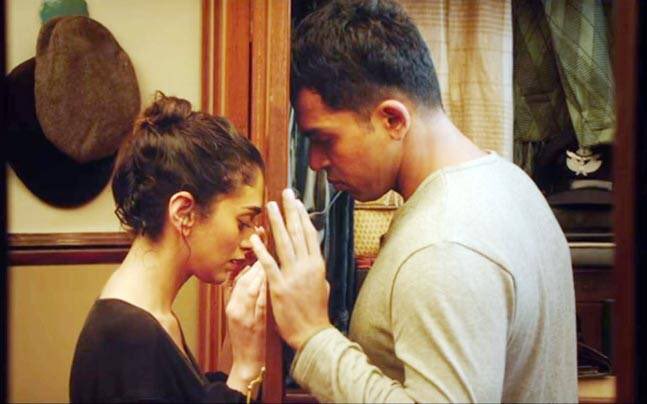
Maniratnam's visual story telling is able to transfer the film's theme of two characters who don't see eye to eye, onto a visual plane, thereby making scenes work at a metaphorical level. When Leela accepts her role as the lesser partner, before confessing her love for Varun, she draws a closet door to create a separation between herself and Varun, forcing them to not see eye to eye. The blocking here is simple and effective. You see a much more extravagant blocking where Varun and Leela are lying on a bed facing each other, but without seeing eye to eye. As their differences about starting a family drives a wedge between them, Leela turns over and leaves Varun with an ultimatum.

The rhythm carries over to the scenes in Pakistan as Varun's party desperately tries to escape. The way the chase ends left me with a chuckle. The film almost ends on a high, as Varun and Leela finally see eye to eye in an endearing scene. But Maniratnam cops out to play to the gallery, (who have summarily dismissed the film as a mokka padam 2) and the characters accept each other as equals, but only in an Orwellian sense. One can reason that this is keeping with how Leela refuses to let go of her adolescent crush on a man she has never met, and whom she desperately clings onto even after being treated poorly. That aspect of her character remains obscure, and one would have to really squint to see how it shapes the climax. May be like life, she is not perfect. So is this film. But on the other hand, it is at least full of life!

Footnotes 

  1. This scene where Leela accuses Varun of treating her like a dog, reminded me of Gautam Menon's Nee Thane En Pon Vasantham, where at point the heroine accuses yet another Varun of treating her like an item on a checklist.
  2. To be fair, one need not be an expert film critic to tell if a movie works. But for a film like this, the answer to that question is more personal. Popular consensus is that cinematography is excellent, which is audience speak for direction is good. Not to take anything away from Ravivarman's work, I don't know anything about cinematography so as to talk about his work in a meaningful way.

Saturday, January 7, 2017

Dhuruvangal Pathinaaru - A fresh approach to direction marred by an ordinary approach writing

Dhuruvangal Pathinaaru by Karthick Narain is an unusual Tamil film. One of the early scenes has a pan shot from the hills to a bungalow at a languid pace. This is a stark contrast to the films that Hari churns out with the pans, jarring cuts accompanied by a whoosh. Tamil cinema has found settings from Chennai to Madurai, but a thriller set in a hill station has been long overdue. Amir’s Raam which also had Rahman was made more than a decade ago. Much like the setting, it rare to see a young Tamil director who strongly believes in showing rather than telling, and keeps at it for the most part. In the early portions, Karthick shows adeptness at his craft. He manages to carve out a pivot when a victim’s identity matches with the blood samples at the crime scene. The direction is interesting and unusual. Yet it does not compensate for the ordinary writing.

Interesting, because Karthick is eager to try out several techniques. A conversation broken into several shots is shot once from behind the shoulder, once within the space of the conversation and again with a different variation. He prefers a steady camera for conversational scenes, and employs handheld to shoot the action scenes. The best scene is when Delhi Ganesh is revealed about his son’s fate. You hear the numbness of the shock, but you are shown the shakiness of the after effect. There is also a strong preference for long takes. Experienced directors and actors screw up oners [1]. Karthick demonstrates an understanding of why they work well; he keeps his character on their feet and gives them something to do [2]. The scene outside Shruti’s apartment with the neighbour and his wife work well largely because it is in a single shot. He manages to even infuse comedy into that scene. But sometimes these shots appear forced. Even in the above mentioned scene Rahman is moved around without a lot of purpose. One of the first scenes at the police station also has a single shot that has a constable appearing way too busy (the movement is composed the character cutting several imaginary corners and he has something to say to somebody at every corner) just to keep the shot interesting.

Unusual, because in several scenes action seems to happen not at the center of the frame, but at the periphery. It is an unusual choice. It works well in the opening sequence. It was surprising to see where the gun was pointed at. Even the altercation with the traffic police is shot in a way you, so that you can fully see the actor but only paritally see the action. You also get a profile shot of only one party in a conversation, where the other party who is not in frame. May be the director wants to keep you guessing about what’s not in frame. Strangely enough there are at least shots were composed starting from a top angle and moving to a perpendicular position with respect to the characters without a specific purpose.

Rahman exudes a lazy elegance that makes an interesting watch. At times, I wonder if that’s due to sloppiness in writing. The writing manages to work well with some character traits that go well with Rahman’s acting. He patiently coaches a new recruit who thinks of a missing person report as a prank call. There is also a short film crew that has a second unit directing a making video of the short film! Karthick seems to follow an unrestrained approach to direction as well as writing, but the latter does not work out as well. You see scenes that begin way too early and end way too late, which slowly becomes a trend. A conversation with a watchman about the investigation slowly becomes a conversation about the watchman. Ineptness of the policemen goes on like a never ending side show, and bloats the investigation scenes. Rahman has a meatier role in this movie, but I liked his performance in Raam better largely because he was supported by better writing. Here the writing is in broad brush strokes, lacks specificity and hopes to manufacture interest from the lack of clarity. Towards the end you can feel a hangover from short films (though not Karthick Narain’s Oomai Kural which features much better and specific writing).

The direction helps create and maintain a sombre tone with a promise that some thing interesting is around the corner. If only the writing had helped the film turn the corner, I would have joined Baradwaj Rangan in a chorus in calling this a first rate film. But the direction shows sufficient promise to believe that one may be around the corner.

[1] - Kabali talks to his gang in a diner after evicting a dissenting member. There is a long take that is too long for Rajinikanth to sustain the intensity of his performance (look at how feeble "Magzhichi" is). Ranjith does not move any of his characters; the extras stick out like sore thumbs, and drains the scene of any signs of life. A scene that's representative of Baradwaj Rangan's synopsyis - "An unsatisfying clash between the impulses of star and director".
[2] - Mugumoodi’s Kudi Vaazhthu has an interesting prelude that has a good long shot. Every Frame a Painting’s The Spielberg Oner.

Wednesday, December 28, 2016

Dangal - masterfully combines excellent writing with great performances


  • It is rare to see a sports movie that sheds a light on what it takes to be a great sports person. Most sports movies ask you to suspend disbelief as the screen writer types in a cheat code to let the underdog win. The training sequences are written beautifully. You see how the underdog transforms into a champion. All it takes to convince one is just the dialogue, "See you at 5 am tomorrow".
  • Surprisingly for a super star driven movie, there are times when Aamir Khan remains in the periphery. The movie is about his character's dream, but the driving forces are his daugthers. The terrific ensemble cast carries the film. When you are not subconcisouly evaluating dialogues for plot (I did not want to scan at the bottom of the scene every time), and only rely on performance of actors to get the emotional cues, it becomes even more engrossing. Even if the actor appears for just one scene, like the child bride.
  • What you see in the children is what you see in the adult actors. There are several scenes where Babita has to watch the drama from the sidelines. Both the actors playing Babita manage to hit the same note when expressing her tentativeness.
  • The child actors excel in comic timing as well. Comedy is one of Dangal's strong points. It is not like they are completely reliant on dialogues. When Geeta wins an older age group championship, you see a banner that reflects that by simply striking out "sub" in sub-junior.
  • Not to mention the fact that the roles are physically demanding. It is hard to imagine what it took for professional actors (Fatima Sana Sheik played Kamal Hassan's daughter in Chachi 420) to come across as convincing in the wrestling scenes.
  • Ritika Singh (of Irudhi Sutru), a professional martial artist was impressive with her one handed push ups, but was severely limited as an actor. And she managed to get a special mention at the National Awards. Going by that standard, it is not a strech to imagine the women here winning all the acting awards.
  • Direction is top notch. While the father is desperate for a son, he seems very distant in relation to his daughters, and you never the father and a daughter together in the same frame. The first time you see them together, (you see him splitting a sweet when his cousin has another son and giving it to the daughters) he is embracing his sleeping daughter, only after he has embraced the idea that a daughter can also fulfill his dream.
  • The same goes for action choreography. Wrestling scenes in the first half are set in montages, and comedy is neatly blended into these scenes. In the second half, wrestling scenes are woven effectively into intense dramatic scenes where the father takes on the daughter. They stand out in wrestling matches, where the voice over commentary comes together with the staging to create quite an atmosphere. Rarely has action been used this effectively to build tension.
  • Many sports films fall into the pitfall taking drama all the way into a sporting finale, but Dangal plays its cards with some restraint. The father is marooned in a far away room, and how he comes to know of the result is even more dramatic. And is staged with some restraint too. (The audience on the other hand decided that they have to stand and observe).
  • The way the role of the coach affects the drama is perhaps Dangal's weakest link. The character had some promise initially but slowly slides into a mean caricature. This has not worked in several film in recent memory (Listen to the theme music of one such character in Kabali, and you will see how dated even the background feels).
  • May be you need to invest a lot more in the other jealous character for these conflicts to come out well. For every Aadulakam (the director introduced the subject to a film festival audience by posing "What would an Alpha male do when an upstart shows up in his territory?") or even Aurangazeb, there are several films where a poorly written character's meanness takes the film down (Irudhi Sutru has two such characters). In Dangal, it is a contrived means to an worthwhile end.
  • Sports has in-built drama, and cinema can easily build on this. Opening and climax cricket sequences in Chennai-28 are good examples. Sports that don't have a wide following are hard to follow, and as result harder to create a drama out of. Some films try to inject the dramatic tension in the plot into the sport (Irudhi Sutru), or have no meaningful drama outside of the sporting action (Vallinam). It is hard to do just one well. Dangal manages to create and sustain two separate dramatic threads and switches between in the climax in a riveting fashion.
  • Production values set a really high bar. The set, costume and more importantly minor characters make you feel the rustic nature of the setting. I am not sure if there ever was a time when big Bollywood money was put to better use.

Sunday, November 13, 2016

Achcham Yenbadhu Madamaiyada - Wackiness of mostly the right kind

After watching Yennai Arinthaal ...  a friend dismissed the film as a mish mash of Kakka Kakka and Vaaranam Aayiram. Recently a journalist put a question to Gautam Menon, asking why his films fail to venture beyond his usual character types and situation1. Then there are people who ask him why the walls are always painted white. Personally, I like Gautam Menon's films, but I hate his characters' collective disdain of personal pronouns. Gautam is probably well aware of the skepticism about his work. When Achcham Yenbadhu Madamaiyada opens with the usual Gautam characters types - an aimless posh area guy with a well documented aversion towards engineering, a well educated career oriented beautiful girl whose GPA matches her hotness score on a Trump scale. And the usual Gautam situation - guy falls for girl and magically finds purpose in life. You should be in a for treat.  And just to piss you off, he extensively references situations from Vinnai Thaandi Varuvaya. Thankfully for some us he is at least cagey about revealing the name of his hero, who resides in a house with walls painted in all shades of RGB. But seriously speaking, Achcham Yenbadhu Madamaiyada works well as a genre film. And you don't see that coming till the film takes an unexpected turn to hit you with the awesomeness of the name of its hitherto unnamed hero.

Gautam's writing comes to the fore in establishing real flesh and blood characters - how they get along, what their aspirations are and how they react in a desperate situation. The chemistry between the hero and the girl injects life into even uneventful every day interactions. You can see it when Simbu relishes at the time spent doing nothing with the company of the girl. I was surprised at the extent to which VTV is referenced, but the references are just spot on. (Here the girl is the one who is into films). And speaking of references, the Godfather moment did not stand out when it happened on screen. I think they had greater success in cutting the trailer as a homage to Godfather. I liked the Godfather reference in Vaaranam Aayiram better, where Suriya on first meeting Meghna recalls the "hit by a thunderbolt scene2". You see the appropriateness of this reference when Meghna tragically meets with a similar end.

Gautam front loads the film with songs, which helps to keep things interesting despite the "and then ..." structure of the narrative. The only moment I was bored was seeing the couple riding towards the camera for 5-6 seconds at the beginning of "Raasali". The real disappointment though has to be "Thalli Pogathey". I don't have issues with the placement of the song, but the picturisation is downright tacky. The only part I liked is when Manjima executes a swirl3 (please don't ask why) and they decided to insert it twice.  Manjima Mohan's casting is a departure from Gautam's preference for powder faced actresses. There are rough edges in her acting, but she has an exquisite presence on screen - especially the flowing hair! A younger actor might have been more suitable for the hero's role, but Simbu is good. He exists at various times as the before and after pictures in newspaper ads for weight loss companies. You sometimes see the latter, but mostly it is the former. That does help when Simbu has to pack a punch in action scenes. A substantial role like this usually brings out some limitation in an actor's technique, even for experienced hands. With Simbu you don't see any of that in AYM.

In second half, the writing adopts "but then... therefore" structure and keeps you interested, but some problems in writing and direction emerge. Let me first address the problems in writing, because there seems to be a minor trend in Gautam's recent films to over write4: a tendency to promise something and then distract the audience into expectation of something that never transpires. In AYM, the hero declares that he will go after the bad guys and determine "Why are these things happening?".  Even though you find the answer to his question eventually, that's not what the rest of the movie is about, so the emphasis is somewhat misleading. And that is also an after thought, because the narrative invents a new character and conveniently assigns the blame to him. I was really hoping that Gautam will use the inevitability of the gun running out of bullets, as an excuse to spare the villain. Instead he concocts a somewhat convoluted explanation for why the hero could not shoot down Kamath. I did not care a lot about logic, but it was somewhat amusing to see when an engineer's ability to sense mortal danger at the nick of time comes in handy as a couple of helmets take a hit on debut.

Gautam's direction is surer in the first half. He is under appreciated for how well he directs comedy scenes. In YA... the unpredictability of a joke's timing really worked well. In AYM, Gautam interestingly cuts from and into people eating, just as the hero contemplates what he wants to do in life. That's literally the only thing he is doing in life! The choice of back-lighting some scenes is interesting, but I am not sure if it was deployed with control5. They seem to randomly show up during fight sequences, dance moves and family dinners. He also shoots a beautiful shot of a sunrise (Okay, no explanation needed). Even though Gautam has helped Ajith and Suriya deliver a better performance than usual, he somewhat struggles to control the performance of newcomers (Manjima to a smaller extent and Baba Sehgal to a larger extent). He does not use Simbu's versatility to avoid narrative overlays as he did with Kamal in Vettaiyadu Vilaydu. You feel that they are overused, especially when used alongside scenes with sufficient action and emotion (when the hero stops fleeing and decides to go after the villains) to convey a feeling. They feel redundant. Their tone seeps into dialogues at times, making down-to-earth characters look unnecessarily boisterous.

Action sequences could have been well directed. Firstly, Gautam decides to stay true to the hero's character and does not have him execute stylized stunts. So you see punches thrown at a full blow repeat in several scenes. Secondly, other creative choices don't jell well with the first choice. In the hotel room fight scene, Gautam does not have sufficient coverage, (especially when another guy join the party) and shoots scenes at close up with a single camera setup. Even though that scene intends to  have an element of surprise, it never comes and you see a prolonged standoff. In the scene where the hero is stopped by Hiren (Daniel Balaji), Gautam manages to throw a surprise but compromises the beginning of the scene. I wonder if they were cramped for time, given that they were making the film in two languages. You can see it when they try to execute a match cut as the hero leaves the hospital, but it appears to miss its mark.

The choice of setting a film in a part of Maharashtra that's not Mumbai is rare for a Tamil film (Only Hey Ram/Katrathu Tamil in recent memory have done it before). Despite what the opening credits say, characters from Maharashtra spoke in Hindi/Marathi (I am not sure if that's an exception. Visaaranai's first half was largely in Telugu, making it sort of a bilingual). Tamil overlays usually sound tacky and is more distracting than the distraction from not understanding a language. And watching the film in Day 3 of Trump's America, when the hero claims he is a "Tamilan da", nobody in the largely Tamil audience cheered and you could hear a few sighs of disappointment.  The film briefly yet conspicuously addresses the politics of the region, with a politician vying for the top job conceals the presence of a wife (and for dramatic purposes a daughter). Sounds vaguely familiar? Also look at the name of some the characters - Nathuram, Hiren and Kamath (Sudish Kamath6?). The only thing more conspicuous is Gautam's brief appearance in the opening credits, which led my friend to believe that he was going to be the pivotal Pune police officer.

The saving grace for AYM is that Gautam is able to combine the good parts of the movie to pull a "R thing" out of the hat in the last act. This effectively makes this a Mass/Masala movie and makes it work despite it flaws7. Several masala movies are churned out as an assembly line production with genre Types instead of Characters in typical situations and a nearly mythical Hero (with a capital "H" and of a Type) who sells mass moments on either side of an interval point. People point out to repeated flaws in lazily made masala movies, and claim that it is a weakness of the genre or Tamil movies in general. Like Agni Natchatram, AYM makes a good case for the genre. It's hero is more desperate than mythical in an endearing way. Mass movies largely work on their ability to sell a mass moment. Take Ghilli's interval block for an example. Several films try to emulate such moments and get them horribly wrong. Take the final scene in The Usual Suspects which has been imported into Tamil without the same effect. The scene works because Kint (a character) becomes Keyser Soze (a type), whereas in Villain the transformation is between two types.

Gautam's writing helps in flushing out the correct kind of characters that makes the film organic, not assembly line. The direction leading to the mass moment is inventive in a wacky way. Never has a text scroll has been more dramatic that the scenes appearing on the screen. And when you see the Character transform successfully to the Type headlined by A. R. Rahman's rap music from "Showkali", the film refuses to be tripped by its flaws and hurtles past the finish line in style. If like the skeptical journalist you are wondering what the heck is different from the usual Gautam fare, let me answer it for you. He places well thought out characters in well thought out situations, and delivers a mass hero movie with a small "h". And you don't even see that coming, until it does.

Footnotes

  1. Tricky Question 
  2. Godfather reference in Vaaranam Aayiram.
  3. That swirl.
  4. In Yennai Arinthaal... it is the "fine line between being good and bad", which makes you expect Victor's character will be fleshed out from the mere flashes you have already seen, and will lead to "fine line" in Satya. Victor's character never traverses that arc, and Satya essentially remains a Mister Goody Two Shoes.
  5. Look at the number of shots with back lighting even in this trailer. For an excellent use of back lighting we need to look no further than Marma Desam. The usage is not just stylistic. It is an existential need to show a character without revealing its identity. In a move that is either a coincidence or a touch of genius, this cinematic technique keeps the character Karuppu (The Dark One) literally in darkness. They also used different color tones consistently to contrast the time period, and then at a pivotal point mix them to signify how the past comes into head with the present.
  6. Of course, you know Sudhish Kamath, right?
  7. AYM does not combine two genres well, like Pisaasu or more relevantly Vishwaroopam does. Look at the mass scene in Vishwaroopam (appropriately described as Pakka mass). The transformation is between types. Even the terrorists in the masala movie portions of Vishwaroopam are types. While Vishwaroopam is effective as a masala movie, it real strengths lie in the portions which are framed within the narration of its masala movie: an emotional drama. When viewed as a political drama, it gives us moving scenes and characters. It allows the hero (a character) to feel the loss of a young terrorist (character) who is brain washed to suicide. Contrast this to the climax in the masala movie portion, where the Hero (type) simply shoots the Terrorist (type) to death. Masala movie as a genre does not allow you to empathise with a negative type. Vishwaroopam is more rewarding when viewed as a political drama, in the same way AYM is rewarding as a masala movie.


Wednesday, July 27, 2016

Kabali - Misfire

Take this scene in Madras, where Ranjith sets up the big reveal. Ranjith uses the literal under the table footise between the lovers as a visual metaphor for the under the table nexus between the two seemingly warring politicians. Notice how the scene has a great rhythm with a clear beginning (pretension between the parties), middle (warmth) and an end (deal). Madras worked mainly because like any good movie, it "did not tell, but showed". That was sufficient to appreciate Madras, even when a viewer has missed the political undercurrent (or the two shots of Buddha in that sequence).

Kabali on the other hand, violates this basic rule of cinema and as a result fails to take off as a movie. Almost everybody in Kabali has peddled drugs, and that's revealed with every character literally telling that to your face in Kuala Lampur slang. The film manages to convincingly answer tell you interesting things about Kabali and his wife, but when it comes to actually showing them it flounders. The temple scene is a case in point. The lengthy interview scene with students is long, and has an unfortunate and then ... and then rhythm to it. When Rajini spends close to a minute telling a fable (of nihilist Tamil nandus) Kabali goes from generic to downright stale. Even worse, the direction at times is poor that you don't even get the intent. That happens when 43 gang attacks Kabali's safe house before he ventures in search of his wife. There is no beginning, or no clear ending. There is nothing to suggest within the scene as to what happened to Kabali. The one second hint of a romantic angle between Dinesh and Dhansika is down right puzzling. It is one thing to have a synopsis of a love story, but to literally shoot it as a synopsis is vera level. What happened, Ranjith?

Ranjith probably wanted to do away with the usual super star build up scenes, or wanted a faster pace for the movie. Unfortunately, this results in poor staging and execution, with jarring jumps between pages of a script, like a Hari movie on steroids. Santhosh Narayanan efforts on the background score provide promising interlude to scenes that don't have much going for them visually. A scene where Kabali rams a jeep into an unsuspecting villain is supposed to mark the ageing man's surprising cold blooded pursuit of revenge. It plays without a rhythm and the moment does not register. To top it off, when the villain suggests that somebody might have pimped his wife off,  Rajini responds with Maghizhchi! The decision to have Radhika Apte's portions play as a series of interluding montages leaves Ranjith with too many fragments to piece together in the first half. The law of averages catches up with Ritwika after Madras and Oru Naal Koothu. She pitches her stoner character way too high which adds to the chaos.

There are only a handful of well executed scenes. The prelude to Ulagam Oruvanukka (referencing lyrics which go like "Paravai Parakka Marakkathe"), and the actual song (with Gana Bala look alikes) were good. Ranjith has the temerity to point out that being a benefactor to the juvenile youth does not excuse Kabali from being showcased as a bad example. He even lets Radhika Apte lord over Rajini (a serial tamer of Tamil cinema shrews) as the over-bearing wife. The best scene in the movie is where Dinesh gets attacked. It is shot from the bottom up, contrasting several top down shots in Madras. The violence and gore is disturbing, and showcases juvenile crime better than scenes in the first half at Free Life school, and stands out like a good thumb on an otherwise sore hand. The editing in the scene is a significant departure from how the rest of Kabali is edited in general. Notice the amount of time the editor waits for Tony Lee to swing his sword waiting for the tension to build. Contrast this with the scene where Kabali cuts the Maghizhchi cake in a flash, where the scene has moved on before you can fully register what has happened. That scene is representative of the jarring quality of editing in the first half. Can some one please explain the one second throw away scene at the swimming pool with Rajini and Dhansika? Second half manages to setup a mood of unease - the feeling that would exist between meaty edge of the seat scenes in a thriller, as a cloud of vulnerability hangs over Kabali. But the problem is that the meaty edge of the seat scenes are missing in Kabali.

One of the two scenes that excited me was catching a glimpe of RJ Tilak and Super Singer Soundarya in unexpected cameos. And speaking  of cameos it is more or less an extended cameo for most the cast. Dhansika manages to look surprised all the time. Dinesh is wasted as a sidekick. So is his on-screen brother from Atta Kaththi. And so are Kalaiarasan, Mime Gopi, Rama (Madras Amma), Madras Johny, Nasser, Gana Bala and Aishwarya Rajesh (I don't remember seeing the last two, but I will just put them here, to be on the safer side). I don't know if it is supposed to be a Venkat Prabhu homage that has gone too far. The only moment that is crafted with some effort (points from at least trying) pays off with Apte showing why she is the most sought actor in the independent movie scene. Rajinikanth, on the other hand is back with a bang. Playing his age he is able to showcase an extra ordinary presence that we have not seen in his recent films. He is mostly good (slips when has to do some rapid tongue twisters in the flash back), and that's one of the few things that Kabali gets right. After seeing the poorly made Lingaa that almost made a joke out of Rajinikanth, I should say some credit should go to the director for directing Rajinikanth in a good performance.

The other scene that excited me was the (intentional?) reference to Aaranya Kaandam, where Nasser answers the question ("What is is dharmam?"). That a Rajini movie references a great movie that made innumerable references to Rajini movies simply blew my mind for a second. On the flip side, Kabali also reminded me of Baasha (borrowing from Godfather), when Tony Lee's enterprise is toppled in a single montage (Sarakku might mean a different thing in KL slang, but I think a yawn is still a yawn). The root cause for most conflicts is petty mindedness and this trope has mostly left me unimpressed (Irudhi Sutru and Kaaviya Thalaivan come to mind). The idea of Rajini playing a character as a homage to Ambedkar and his politics sounds interesting on paper. But Ranjith focuses too much on the personality cult of Ambedkar, and in the process reinvents one of the most important leaders of the independence era as a Dalit fashion icon. And instead of being a movie that puts an end to questions about Rajinikanth's super-stardom, Kabali draws unnecessary attention to the questionable practices that sustain super-stardom.